


1. Introduction
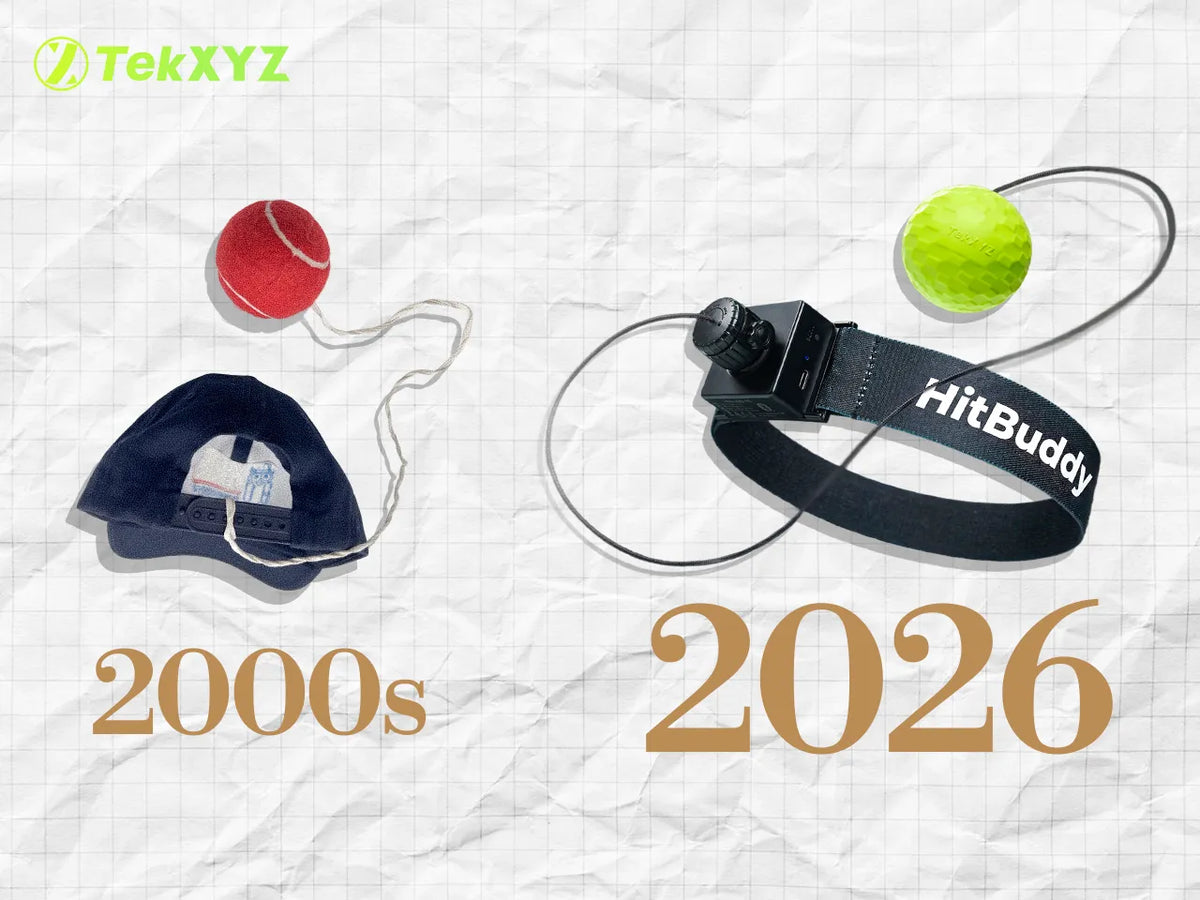
A boxing reflex ball may look simple: a small ball attached to an elastic cord and worn on the head or body for repeated striking and reaction training. On the left of the banner is a simple DIY tennis-ball version; on the right is the latest, more sophisticated HitBuddy from TekXYZ, featuring a built-in counting sensor and a glowing ball. What happened between these two points, and how did the boxing reflex ball evolve?
Its history, however, is especially difficult to pin down. Publicly available evidence does not point to one universally recognized inventor. Instead, it appears to have developed through a combination of older reaction-training ideas, wearable training experiments and boxing DIY culture.
This article focuses on that publicly traceable development path, from earlier precursors and early documentation to commercialization, popularization, and the product’s more recent directions.
2. Origins
Earlier Training Logic: Double-End Bag (1950s)
To understand the history of the boxing reflex ball, it helps to begin with an older idea rather than an older product: rebound-based reaction training. A clear example is the double-end bag, which is tethered at both the top and bottom and rebounds sharply after being struck. TITLE Boxing’s history overview notes that the double-end bag became widely popular in the 1950s, especially after figures such as Sugar Ray Robinson helped draw attention to it. While the double-end bag and reflex ball are not the same tool, they share an important training logic: both force the user to react to a returning target rather than simply hit a stationary or slow-swinging object. In that sense, the reflex ball looks like a more portable and more wearable branch of an older training tradition.

Early Precursor: Head-Mounted Reflex Football (1962)
One useful early reference point appears outside boxing. U.S. Patent 3,042,404, Football Practice Gear, issued on July 3, 1962, described an American football training device using a headband, an elastic tether, and a returning object. It identified two main purposes: to enable independent self-training and to speed up practice while placing greater demands on players’ reflexes and coordination. No clear public evidence has been found showing whether the concept was widely adopted in training or commercialised. However, this patent signals that the combination of ‘head-mounted’ and ‘ball’ training was already being explored decades earlier.

Related Prior Art (2006)
Another important marker is a German design registration published on April 20, 2006 for a training device intended for ball games, skill sports, or martial arts. According to the available description, the device used a spherical object, an elastic pendulum line, and, in a preferred embodiment, a headband.

Together, these records show that recognizable wearable rebound-device concepts existed before the modern boxing reflex ball was documented in the early 2010s.
3. Modern Form and Commercialisation
Modern Documented Form (2011–2012)
The strongest documentary milestone for the modern boxing reflex ball is U.S. Patent Publication US20120225754A1, published on September 13, 2012 and claiming priority to March 1, 2011. It describes a wearable reflex-training device built around a soft ball, an elastic tether, and an attachment point on the athlete, with emphasis on portability, unpredictability of return, and practical product construction. The patent also states that such reflex devices had “recently” been developed for martial-arts training. This does not necessarily prove that the device was first invented in 2011. It does, however, provide a firm public record showing that the modern concept had clearly emerged by the early 2010s.

The patent record shows that a recognizable modern form already existed before many of the clips and retail examples that later drew wider public attention. In historical terms, 2011–2012 is therefore one of the safest anchors for the category’s documented existence.
DIY and Public Boxing Circulation (2012)
By 2012, the reflex ball was not only present in patent language but also circulating publicly in boxing DIY culture. On January 11, 2012, Ross Enamait, an American boxing and conditioning coach, published a post titled “Tennis Ball Reaction Training,” describing what he called an “elastic head ball” for hand-eye coordination and writing that all a user needed was “a hat, a tennis ball, and an elastic cord.” On January 23, 2012, he followed up with a second post showing the DIY construction in more detail, including how to puncture the tennis ball, thread the cord through it, tie it off, and attach it to a hat. These posts are significant because they show the reflex-ball concept functioning not as an obscure patent idea, but as a real training drill being shared with the boxing public.
 At roughly the same time, boxing communities online were discussing similar methods. An early-2012 Boxing Forum thread, for example, linked directly to Ross’s post and treated the drill as something boxers could try for themselves. This does not prove who first invented the method inside boxing circles, but it does show that the idea had already entered public training culture. By early 2012, the reflex-ball drill was clearly something boxers and enthusiasts could imitate, build, and practice for themselves.
Commercial Retail Emergence (2016)
2016 marks an important moment in the commercial emergence of the PU-based reflex ball. One of the clearest public markers is Creative Boxing’s TAP Ball. Its official Korean product page lists the product as made in Korea and gives a release month of July 2016. TAP Ball featured a smooth 2.75-inch PU foam ball paired with a black elastic cord about 1.5 mm in diameter, a combination that appears to have anticipated the form later adopted by other brands over the following decade. This does not prove that TAP Ball was the first retail reflex ball in the world, but it is strong evidence that by around 2016 the reflex ball had become a recognizable consumer product rather than only a homemade boxing drill.
This commercialization phase matters because retail sales made the reflex ball easier to recognize, imitate, and reproduce across the market. That repeatability likely helped the category spread to a wider range of consumers.

Lomachenko Helps with Global Popularization (2014–2017)
If the mid-2010s helped establish the reflex ball as a product, the later 2010s appear to have brought it to a much wider public. Vasyl Lomachenko became one of the most important figures in that shift. Ross Enamait wrote in 2017 that fighters such as Lomachenko had “once again popularized” the tool, which gives the claim a more explicit textual basis. A concrete visual example is the clip “Fight Ball! Vasyl Lomachenko workout,” which shows him striking a ball attached by an elastic tether while mixing in rhythm, directional changes, and coordination-based movement. Together, Ross’s wording and the publicly available video make the popularization point more specific and more supportable, and suggest that Lomachenko helped bring the reflex ball to much wider public attention within modern boxing culture.
4. Innovation Beyond the Traditional Reflex Ball
App-Supported Play and Gamification (2021)
Another major shift came when the reflex ball began moving beyond purely physical training into connected and app-supported play. A particularly notable example is Boxbollen. Forbes reported in 2025 that Boxbollen had launched a companion app in 2021 that allowed users to upload videos and compete with one another. Boxbollen’s own website and its app-store listings further show that the brand later developed this connected product logic through app-based play, challenges, and online competition. This was more than a software addition. It also reflected a broader shift towards a social, competitive, and gamified product. In this stage, the category moved closer to the logic of connected consumer play, where performance, sharing, and digital interaction became part of the experience.

Visual and Hardware Innovation (2025)
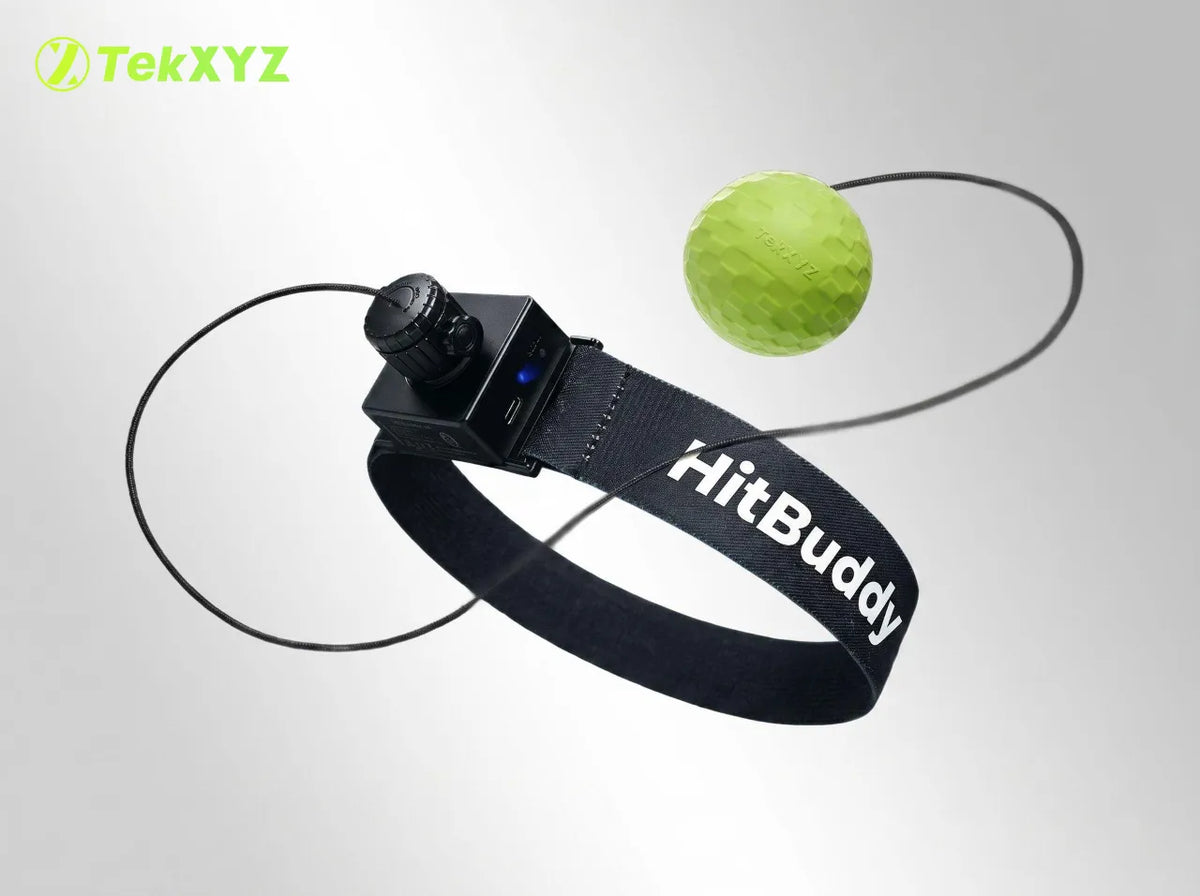
TekXYZ has contributed to the category through both visual product innovation and sensor-based feedback. In 2025, it launched GlowFlex, a glow-in-the-dark reflex ball activated by exposure to a UV torch. The purpose of this feature is not to encourage training in darkness, but to create a distinctive visual effect that users can enjoy, film, and share. Later that year, TekXYZ introduced HitBuddy H1, which adds real-time counting and voice-guided interaction. Its headband-mounted sensor tracks hits through movement, offering a convenient counting experience without requiring an app. Together, GlowFlex and HitBuddy H1 reflect an effort to push the boxing reflex ball beyond its traditional form, exploring new possibilities in both aesthetics and functions.

Community, Challenges, and Marketing Strategy (2025~)
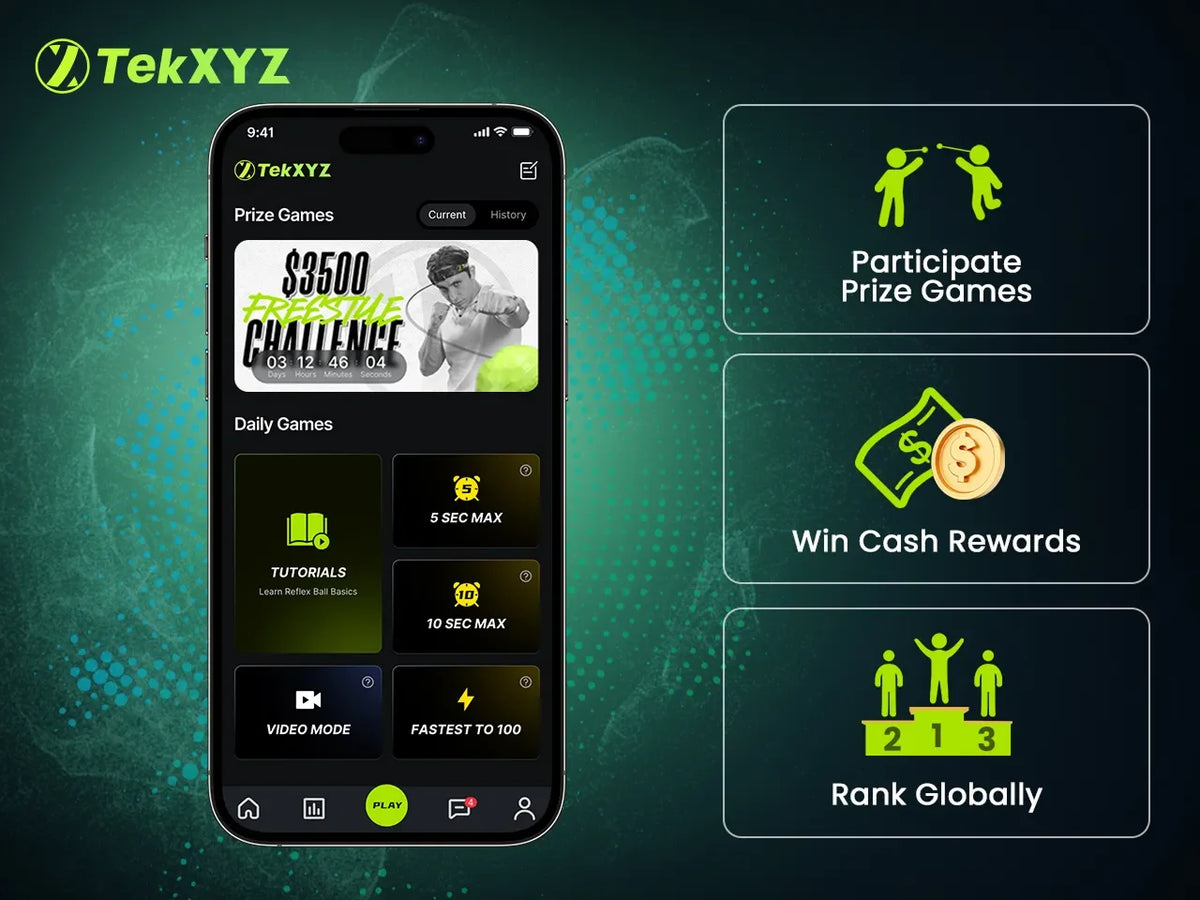
Brands also differ in how they approach community building. If “community” is understood as a group of people connected through shared participation, both Boxbollen and TekXYZ have developed app-based communities and launched global challenges to strengthen user engagement. Beyond standard features such as video posting, sharing, and rankings, Boxbollen offers public and private chat rooms as well as person-to-person challenges, while TekXYZ stands out for its video-comment function, which allows users to hold more focused discussions around a specific skill, technique, or idea.
The sharper difference, however, may lie in how each brand designs its award challenges. Boxbollen’s prize-based events have generally been overtly competitive, rewarding users for hitting faster or hitting more. TekXYZ, by contrast, has taken a more mass-oriented approach aimed at encouraging broader participation and sharing. In 2025, for example, TekXYZ launched its first Freestyle challenge, where success depended less on speed or total hits than on how fun, creative, and engaging a performance was, as reflected in the interaction it received. The event drew participation from ordinary users as well as influencers, and both groups contributed to some of its most impressive and enjoyable freestyle showcases.
The two brands also differ in marketing strategy. Boxbollen has leaned on a celebrity-first approach, working with high-profile names such as MrBeast, Tom Brady, and Snoop Dogg, while TekXYZ has focused more on influencers with genuine stories, hands-on experience, or long-term interest in the boxing reflex ball itself. This divergence has created more room for different types of users, different styles of participation, and different directions for product and platform development. In that sense, competition between these models may create not only more consumer choice in the present, but also more opportunities for the future of the industry.
5. The Market Today: Four Visible Product Paths
Today, four main product paths are visible in the boxing reflex ball market.
The first path consists of professional combat-sports brands that treat the reflex ball as a formal training accessory within a broader boxing-equipment catalog. Publicly visible examples include Rival, Venum, Everlast, and TITLE Boxing. In this product path, the reflex ball is made heavier and harder, and it moves faster to train reaction and coordination.
The second path includes lighter, consumer-oriented reflex-ball products without a broader app or community layer. Public examples include Tap Ball, Boxaball, and Decathlon’s boxing reflex ball. These balls are generally made of polyurethane (PU) and emphasize softness, durability, portability, and ease of use.
The third path includes app-connected or digitally extended product systems. Publicly visible examples include TekXYZ, YMX BOXING, Champs MMA, Boxbollen, and Soul Shift. In these cases, the reflex ball is no longer positioned only as a physical training object. It becomes part of a wider product logic that may include app-based play, hit counting, challenges, leaderboards, video sharing, or broader online participation. This path is especially significant because it shows how far the category has moved from its earlier drill-based origins.
The fourth path encompasses all other specialized segments. A notable example within this niche is Fightball, a Ukrainian brand specializing in handmade leather reflex balls. These balls are meticulously crafted from tailored Italian leather, offered in various colors and featuring artistic patterns, such as stylized fists on the surface, which imparts a distinct aesthetic appeal.

Taken together, these product paths suggest that the boxing reflex ball is no longer one simple object with one clear market identity. It now sits somewhere between boxing equipment, consumer fitness product, skill toy, and connected play system. That diversity is one reason the category’s history matters: the reflex ball did not merely survive from its earlier forms, but continued to branch into different kinds of products for different kinds of users.
6. Conclusion
The exact origin of the modern boxing reflex ball remains difficult to pin down with certainty. What the public record suggests more clearly is a development path: from older rebound-based training logic, to wearable head-mounted reflex designs, to tennis-ball-based DIY boxing practice, and finally to retail commercialization and wider popularization. Seen this way, the boxing reflex ball is less a single sudden invention than a product idea that gradually took shape through adaptation, imitation, and refinement.

Leave a comment
This site is protected by hCaptcha and the hCaptcha Privacy Policy and Terms of Service apply.